

The Nasdaq is on a wild, thrilling run, tech-driven wave. In the mid July 2026, the overall index recorded a staggering 30% gain, and its technology sector 1Y return reached a massive 48%. Meanwhile, an investor’s portfolio unexposed to technology sector would result in an even return. This highlights a techno-frenzy season that we are seeing the Semiconductors ETF (SOXX) soared 135%% in the same period.
The answer to this: AI-related capital expenditure (CapEx) is reshaping the Nasdaq. A profound transformation driven by an unprecedented surge in, a historic multi-year investment cycle projected to approach nearly $700 billion. As tech giants race to secure the physical and digital infrastructure required to train and deploy advanced AI models, their capital allocations are sharply pointing toward heavy infrastructure plays. AI CapEx relative to nominal US GDP now has reached 1.4% of total nominal GDP led by computer hardware, data center construction and advanced networking equipment.
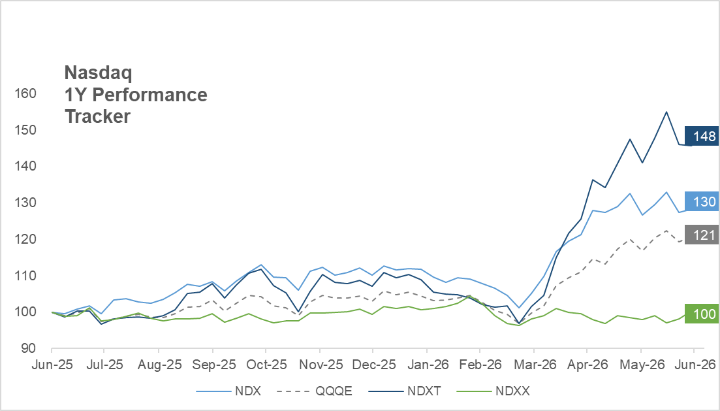
Exhibit 1. Index tracking Nasdaq 1Y Performance Cross-sector, Investing.com 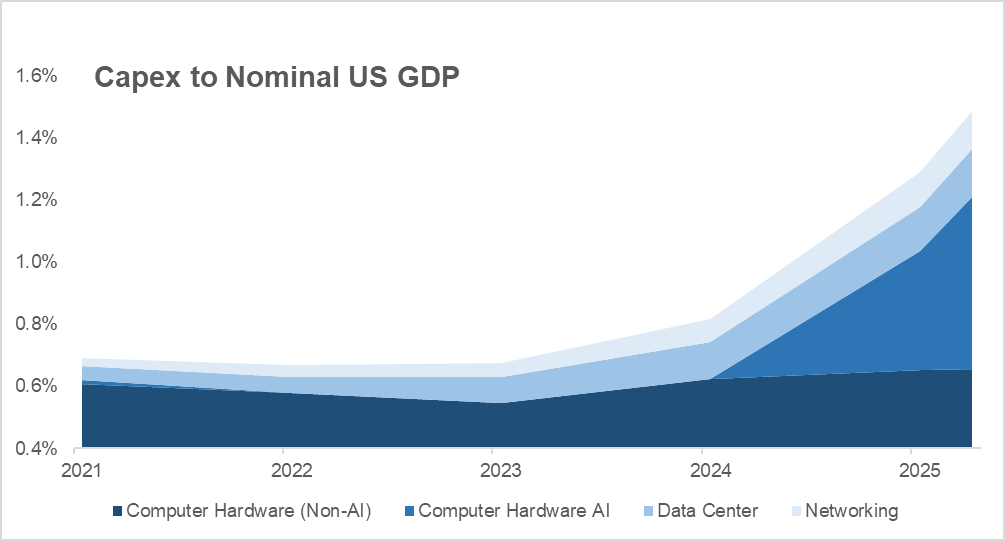
Exhibit 2. Capex to US Nominal GDP ratio, Bureau of Economic Analysis via FRED
Crucially, this AI boom is being spearheaded by a group of hyperscalers (Amazon, Microsoft, Alphabet, Meta, and Oracle) whose massive spending plans act as the primary engine fueling global tech growth. Analyst median consensus estimate indicate that combined 2026 CapEx for these five firms alone will reach a staggering near $700bn, up dramatically from prior years.
Amazon leads absolute allocations at roughly $200 billion, focusing heavily on building cloud compute capacity via proprietary silicon and high-end accelerators. Alphabet and Microsoft follow closely; Alphabet has nearly doubled past allocations to target $180–$190 billion, while Microsoft is pushing its CapEx-to-revenue ratio to historic highs to satisfy booming cloud ecosystem demand. Meta’s estimated $125 billion spend represents one of the fastest YoY data center scaling efforts in corporate history. Meanwhile, Oracle has pursued highly accelerated infrastructure plans despite carrying a significantly smaller equity base and higher leverage than its peers.
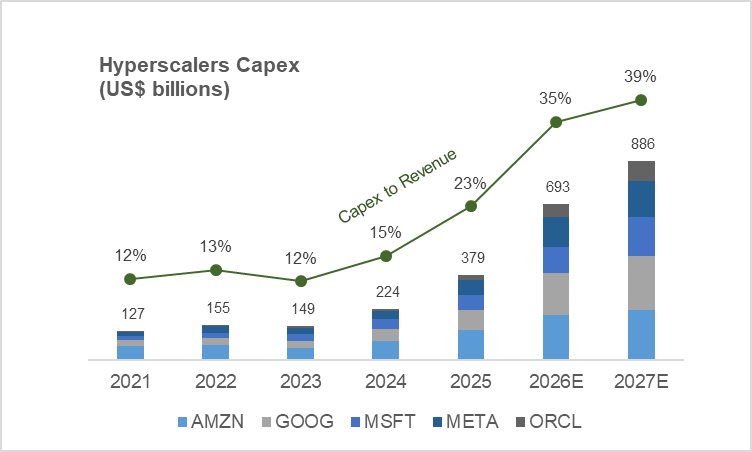
Exhibit 3. Hyperscalers Capex, Finbox 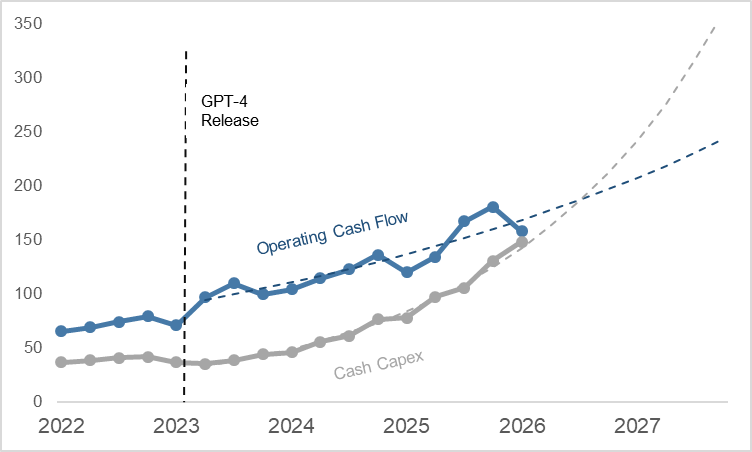
Exhibit 4. Hyperscalers Operating Cash Flow Projection since GPT-4 Release, Finbox
Since the release of GPT-4, the aggregate AI spending of these hyperscalers has surged from consuming 33% of their operational cash flow in 2023 to an estimated 93% in 2026. While the hyperscalers themselves face intense margin scrutiny from Wall Street, their massive spending creates a powerful downstream tailwind for the global AI supply chain, boosting semiconductor and physical infrastructure earnings.
Outrunning Obsolescence: $GOOG CapEx as a Defensive Strategy
Alphabet (Google) announced intention to raise $85bn capital in the first June 2026, one of the largest in the US corporate history. This followed a massive billions dollar debt issuance earlier in the year, bringing Alphabet's total fundraising to a staggering $137 billion in a span of six-month period.
The series of fundraising were designed to fund the infrastructure boom for building data centers, purchase of advance AI chips (GPUs/TPUs), securing massive power grids to keep up with unprecedented customer demand for Google Cloud & AI features and a $40bn investment commitment to Anthropic.
The move quickly caught the market off guard because Alphabet has spent over a decade rewarding investors with higher earnings per share (EPS) through aggressive share buybacks for over a decade. However, despite sitting on a $127 billion cash cushion, Alphabet's aggressive fundraising signals an institutional urgency: in the AI race, investing heavily now is cheaper than losing market share later, even if it means committing a more expensive one (cost of capital).
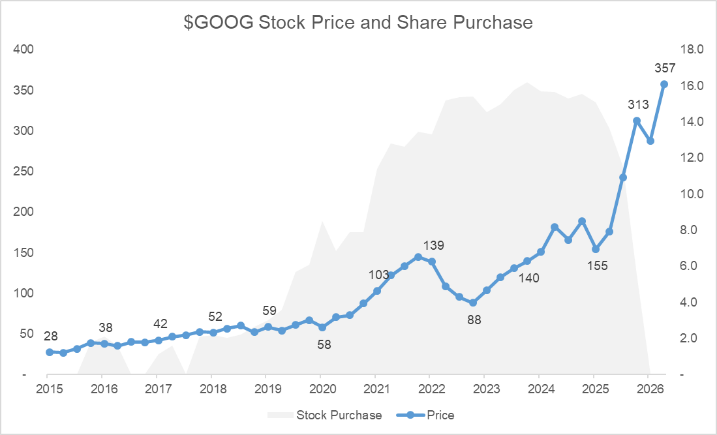
Exhibit 5. Alphabet ($GOOG) shares performance and shares buyback, Finbox
On the Q1 2026 earnings call, Alphabet CEO Sundar Pichai noted that compute supply—not demand—is the company's primary constraint. By raising capital today, Alphabet is locking in scarce hardware supply to secure future demand. Waiting for demand to perfectly materialize before building out capacity risks business obsolescence. Still, investor reactions remain mixed. Investors are increasingly scrutinizing Alphabet's low revenue-to-CapEx ratio, questioning when and if these massive infrastructure investments will turn in higher AI service monetization rate.
What was Meta AI Compute Excess All About?
The market was shaken when Meta announced it would begin selling its own "excess compute" capacity. This highlights a fascinating paradox: while Alphabet is intensely supply-constrained, Meta is actively packaging its surplus data center (AI compute excess) capacity into a new commercial line of business.
While CEO Mark Zuckerberg has kept structural details vague, Wall Street is weighing two distinct business models for "Meta Compute":
- A Hosted Model Service: Developers pay to query AI models directly, including Meta’s own proprietary model, Muse Spark.
- A Neocloud Infrastructure Model: Meta directly leases raw GPU capacity to third parties.
The day of the announcement, Meta’s stock surged into the top 10% intraday, while established neocloud players took a major hit: CoreWeave ($CRWV) fell 10% and Nebius ($NBIS) dropped 12%, triggering a 6% correction in the broader SOXX ETF. Paradoxically, Meta had previously signed roughly $48 billion in combined agreements with CoreWeave and Nebius to handle its own AI training workloads while its proprietary data centers were under construction. Investors viewed Meta's shift into selling compute as a predatory shift that directly threatens the revenue models of its former infrastructure partners.
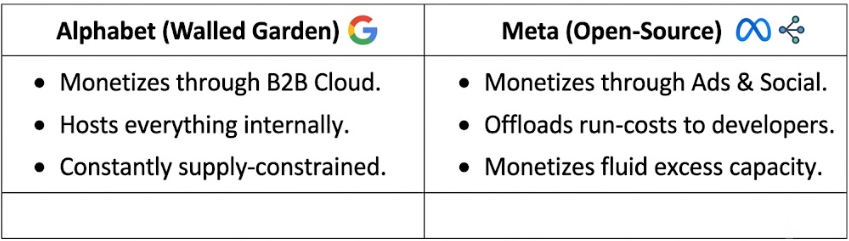
There is foundational difference between Alphabet and Meta. Alphabet serves a vast and diverse external enterprise client base with its Google Cloud. The company is supply-constrained because its customer base and internal products eagerly devour every microsecond of compute capacity as fast as data centers can be built. In contrast, Meta is fundamentally a social media and advertising giant. It lacks a traditional, broad enterprise cloud client base, having built its massive data center footprint primarily to optimize internal ad-targeting algorithms, user engagement on social media and train its own next-generation models.
The difference is in the approach of software distribution and assets optimization. Alphabet uses a "walled-garden" approach. They keep their AI models locked away and charge developers a premium fee every time for the usage since Google has to host everything on its own servers to protect this business, they are forced to massively expansive cycle by building more data centers.
Conversely, Meta is a social media and advertising giant. It lacks a traditional enterprise cloud client base. It built its massive data center footprint to optimize internal ad-targeting algorithms, boost user engagement, and train its open-source models. By giving away its AI models for free, Meta shifts the heavy, daily operational cost of running those models onto the developers' own servers.
While Meta's CFO, Susan Li, noted that the company historically underestimates its long-term compute needs, entering the market as a secondary seller allows Meta to remain capacity-fluid. Selling cyclical excess capacity lifts the financial burden of idle hardware off its books and converts an expensive cost center into a direct revenue driver.
The Builders that Get Paid
There are notable companies securing backlogs by pouring concrete, install power grids and set up cooling systems. Comfort Systems USA ($FIX) handles the essential work of installing cooling, electrical, and mechanical systems. Their 1Q26 revenue jumped 57% and also seen margin improved from 11% to 17%. They boast a record $12bn backlog, with tech projects now making up over half of their revenue. Having generated $1bn in free cash flow in 2025. Emcor ($EME) who operates a similar business model also seen its backlog improved by 33%YoY, its exposure to healthcare, government, and energy projects provides a safety buffer if tech spending hits a bump.
On the midstream, Talen Energy ($TLN) selling power straight to hyperscaler. The company owns the Susquehanna 2.2 GW nuclear plant and secured a highly coveted 17-year, 1,920 MW power-purchase agreement with Amazon Web Services (AWS) ($AMZN). This deal provides an unparalleled $18 billion in contracted revenue through 2042, offering the longest revenue visibility in the sector from a single committed hyperscaler.
Sitting at the end-stream, CoreWeave ($CRWV) stands at the fragile end of the infrastructure spectrum. Its business model relies on borrowing heavily to purchase Nvidia GPUs and then renting them out to secondary tech clients. On the surface, growth looks explosive: Q1 2026 revenue jumped 112% against a massive $99bn backlog. Under the hood, however, the Company is deeply unprofitable, bleeding a $740 million net loss in the last quarter while funding a massive $31–35 billion 2026 capex budget partly through expensive 9.75% senior notes. Furthermore, CoreWeave faces extreme customer concentration, relying on Microsoft for roughly 67% of its 2025 revenue.
The structural danger of this highly leveraged model was exposed when news broke that Meta, which had signed a massive $21 billion cloud deal with CoreWeave only months prior, plans to launch "Meta Compute" to sell its own excess AI capacity to outside customers. This threat of a primary customer transforming into a direct competitor triggered an immediate 10% drop across the entire neocloud sector.
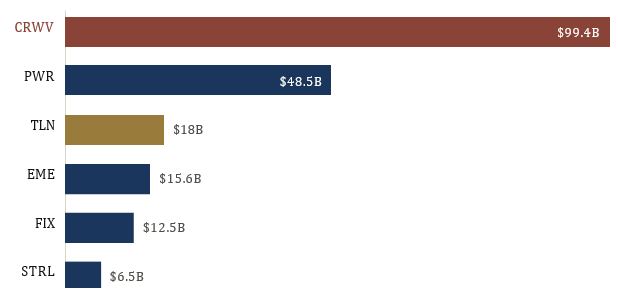
Exhibit 6. Backlog revenues, 10-Q SEC Form
The Semiconductors Rally Saga
The CapEx boom is having an extremely positive impact on the recipients of this spending today. Since investors are mulling on the fundamental questions on how AI will reshape the global economy and the investment return committed by tech giants, semiconductor (semiconductors, memory and electronic components) stocks were appreciated along with their immense pricing power and strong earnings. The key is the free cash flow, where hyperscalers are ramping up investments and the money are flowing to AI supply chain manufacturers.
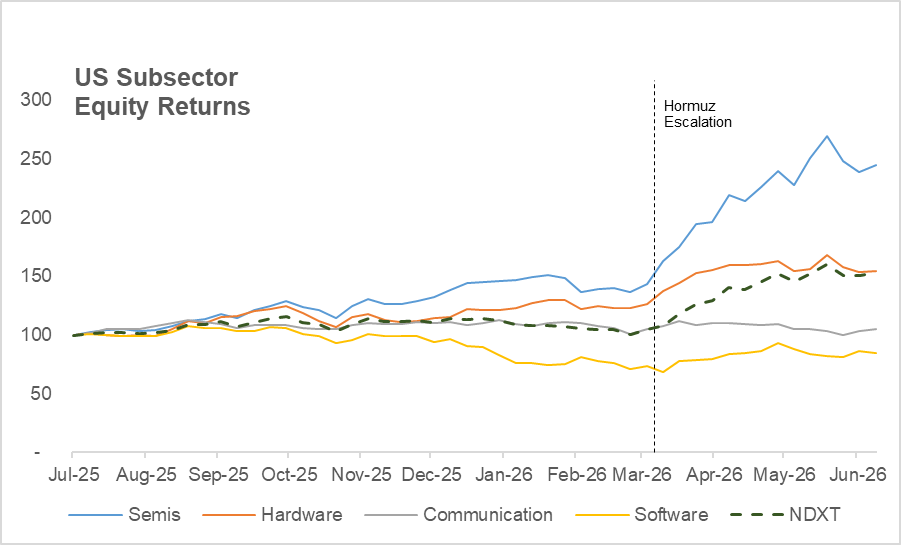
Exhibit 7. US Subsector Equity returns, tracking semiconductors ($SOXX), Hardware ($AIPO), Communication ($XLC) and Software ($IGV), Investing.com.
Building semiconductors involve heavily complex process and high-skilled workers. Think a company like ASML with its superiority, it is the only company in the world capable of manufacturing Extreme Ultraviolet (EUV) and High-NA EUV lithography machines. Without these systems, the world's premier chip companies (like TSMC, Samsung, and Intel) cannot produce transistors smaller than 7nm, effectively blocking them from manufacturing modern AI accelerators, smartphone processors, or high-bandwidth memory (HBM). While building the machine takes several years from producing to operating, explode in demands created this bottleneck to persist in upcoming years.
Micron (alongside SK Hynix and Samsung) sit at the top of memory chain. On the 1H26 earnings call, Micron recorded gross margin at 85%, tripled from the 2024 levels and the HBM & SSDs segment annualized run-rate is expected to exceed its data center business alone. The entire HBM capacity was fully sold out by late 2025, heavily de-risking its future cash flows. The bottleneck is clear, the executive VP & CFO Mark Murphy expected market tightness would continue beyond 2027.
The AI supply chain manufacturers company are celebrating this earnings boom. Even though companies like Micron have seen their stock prices skyrocket over the past year, their valuations remain historically constructive. Micron's trailing P/E sits at a reasonable 22x, while its forward P/E closed last week at a remarkably cheap 6x. Similarly, the broader SOXX semiconductor ETF trades at a forward P/E of just 22x.
Skeptics argue these low forward multiples are artificially depressed by overly optimistic future growth forecasts. However, the underlying driver of this rally is realized earnings: investors are aggressively rewarding the clear winners of the hardware bottleneck.
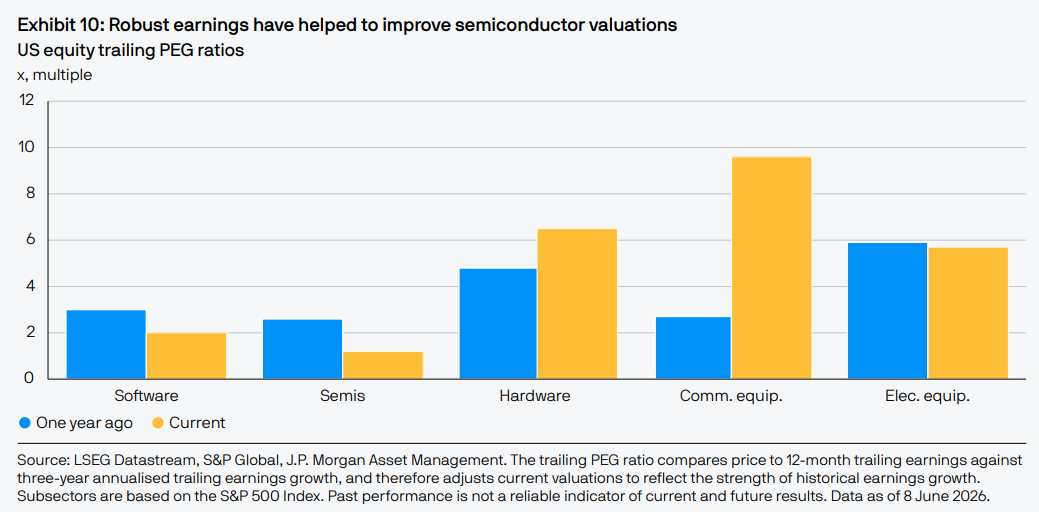
However, the laws of supply and demand cannot be avoided in the long run. It is structurally unsustainable for a single subsector captured a huge portion in the industry’s profit pie. A catch up scenario is highly probable when capital spenders’ AI demand are finally validated, allowing them to lead in industry and rewarded with more backlogs and profitability. Another scenario is a catch-down, a slower AI monetization rate by the spenders will result in broader pullback in AI infrastructure spending and semiconductor sector is likely to get hit the hardest as earnings are priced in into the asset class.
There is a reason why a discounted stock sits cheap, and a rallying stock surges. While the current bottleneck still provides possible further upside, risk management should come first.