
The first half of this year was dominated by the memory names in the semiconductor sector. Names like Micron, SanDisk, SK Hynix and Samsung were being talked about by everybody. Micron market cap skyrocketed almost 3 times and the stock rallied hard when the Hormuz escalation began. In the whole second quarter, Micron gained more than 240%, Intel 216%, and AMD almost tripled. At that time, many believed memory would lead the AI trade for a long time.
Entering into the third quarter of this year, the market has changed its mind and we have seen the last three months belong to the CPU stocks. Micron’s fiscal 3Q26 earnings became the peak and the DRAM universe was already in bear market territory seven trading days later. In mid-July, analysts estimated SK Hynix's second-quarter profit 8% below consensus as HBM4 shipments were slower than expected. SK Hynix fell 15% in one day in a heavy leveraged trade, the biggest drop in its history, and the Roundhill $DRAM ETF lost 9% that same day.
CPU names went the opposite way. In the third week of July, Intel announced they beat the EPS estimate by double and the stock rallied three days before the announcement made by Lip-Bu Tan. Another catalyst, $INTC jumped about 9% after reports it will raise PC processor prices by 10% in October, its third price increase this year. Just recently, AMD joined the $1 trillion market cap club for the first time as the AI trade came back.
So what happened here? It would be easy to say memory demand is finished. I don't think so, and I think this is the most important point to understand.
Memory Might Start Lagging
Memory makers are still reportedly sold out of DRAM and HBM until 2027. The rule always has been pricing power is the most apparent sign of supply tightness. The business is doing very well. Micron's gross margin in its last quarter was at ~85%, that’s a fantastic number and is at a level we usually only see in software companies, not in a factory business. The problem is not whether memory is good. The problem is that everybody already knows it is good.
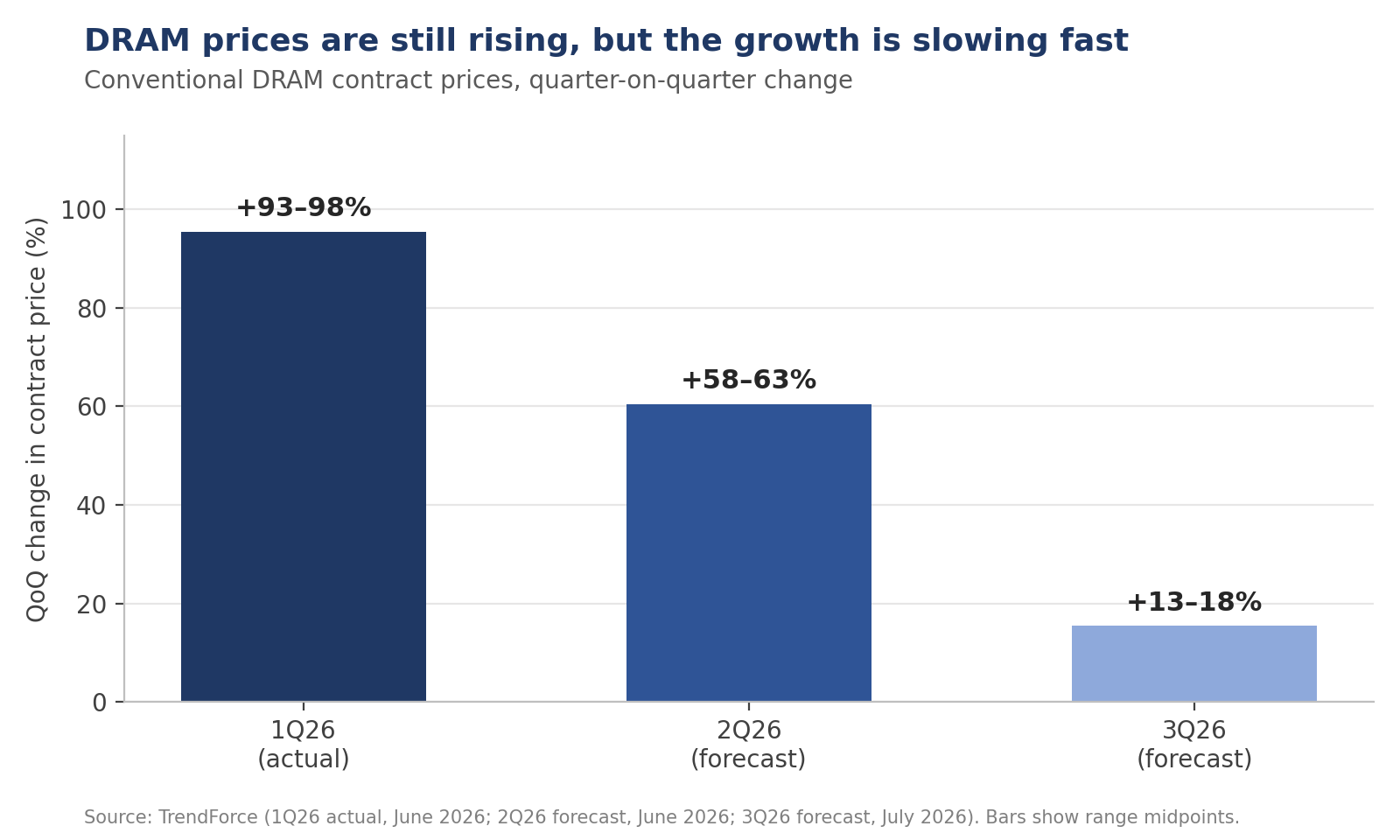
The market started to worry about the peak. The Korean memory duo, SK Hynix and Samsung still raised DRAM prices by around 30% and more than 40%. But the positioning for Memory trade is at a stage where the risk might be at the same level of its reward. Then Kioxia's CEO said prices had probably risen enough after NAND jumped 70% last quarter. When a supplier itself says prices are high enough, investors read it as a sign that peak earnings may come in lower than hoped.
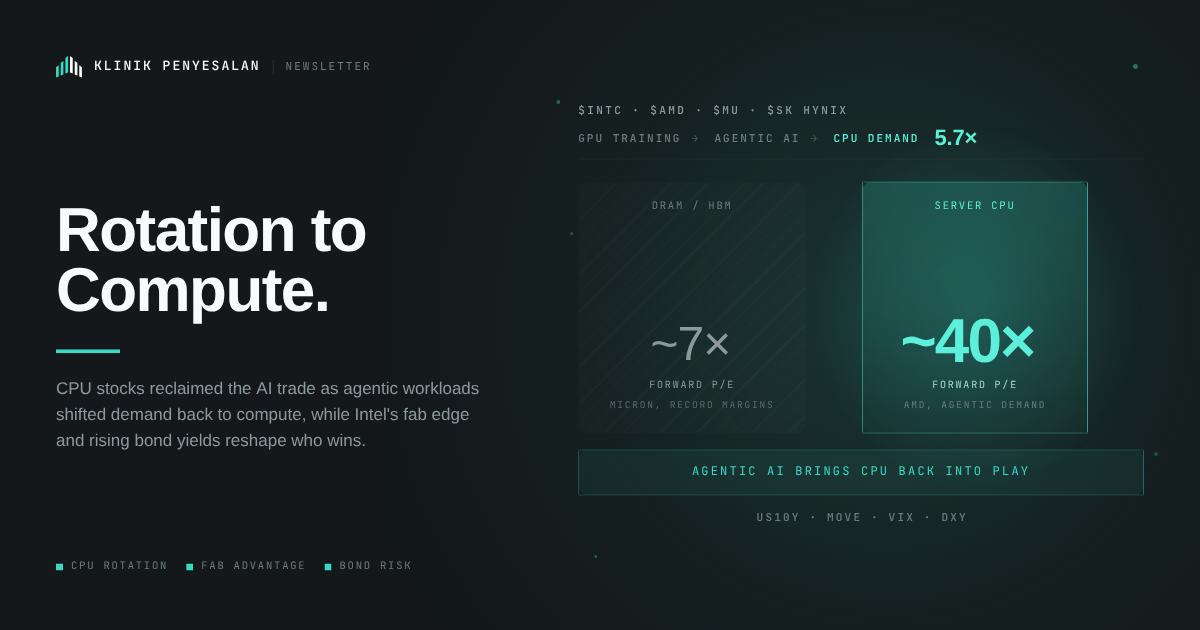
An investor might look at AMD forward P/E is already at ~40x, while Micron sits at ~7x even with record margins. That’s how cyclical works: good times now, eventually the cycle peaks and I’m not saying now is the time.
Agentic AI Brings the CPU Back into Play
The artificial intelligence trade has been an Nvidia story built on GPU in the last three years. Training big models and answering chatbot questions needed huge clusters of Nvidia chips, and the CPU was almost forgotten.
Agentic AI changes this. The GPU does the “thinking” by generating tokens, the chunks of text an AI model produces. AI agent has to act on that thinking. It calls tools, runs code, retrieves documents, queries databases and does the next thing. Those tasks run on the CPU. If the CPU is slow, the expensive GPU just waits. So CPU performance now affects how well the whole AI system is used.
|
|
|
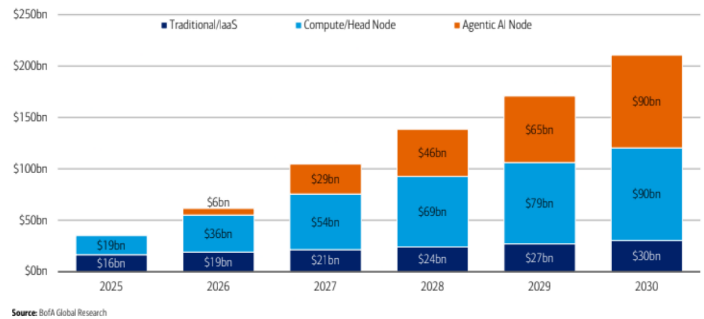
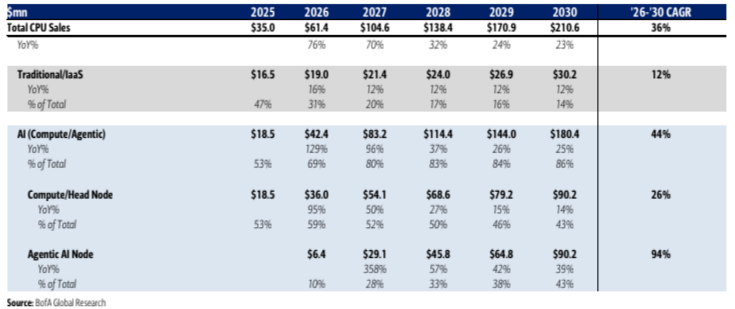
Bank of America, as reported in public coverage, expects server CPU sales to grow from $61.4 billion in 2026 to $210.6 billion in 2030. AI CPU units could go from 16 million in 26E to 53 million 30E (~35% a year), which means CPUs would outnumber AI accelerators (GPU and custom chips/XPU, combined) by about 1.5 times, versus only 0.7 times today. Prices are also expected to go up, with the average server CPU rising from around $1,600 to $2,600. More units and higher prices at the same time is the best setup any chip company can have.
Not only projections, Intel's second-quarter revenue grew 25% to $16.1 billion, its Data Center and AI business grew 59%, and hyperscaler demand was bigger than the supply Intel could provide. Last week, Akamai signed an $11.6 billion, seven-year deal with Anthropic specifically for CPU workloads. Nobody signs a seven-year contract that big unless they are worried about not getting enough supply.
AMD's CEO Lisa Su has been careful to say this CPU demand is mostly additive, because agents still need accelerators to run the models underneath. It is somewhat become a truth. This is not the CPU replacing the GPU. It is the AI system getting bigger and more complete.
Intel Has the Fab to Prevail in the Long-term
My choice is Intel in the CPU group. Two years ago, Intel was the company everybody wanted to avoid. But I think the market still looks at Intel only as a CPU turnaround story and misses its biggest difference: Intel owns its fabs.
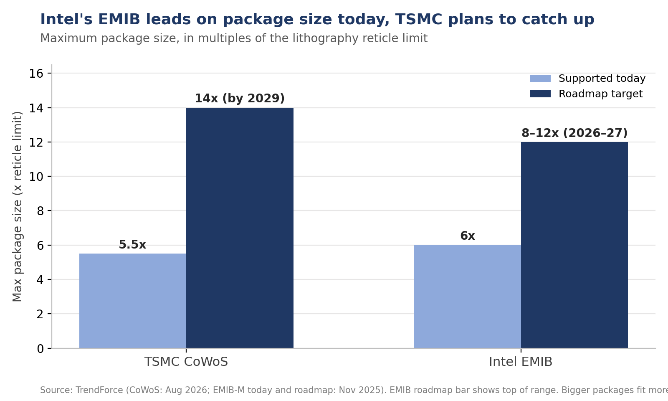
Most of its competitors, including AMD, design chips and then depend on TSMC to make and package them. Intel can do the design, the manufacturing and the packaging itself, on American soil, and it is even partly owned by the US government. For me, this fab advantage opens three doors that a fabless company cannot open: selling its EMIB-T packaging to other chipmakers, developing its own new memory technology, and a possible deal where SK Hynix makes memory chips inside Intel's Ohio site.
First, the EMIB-T. The bottleneck in AI chips today is not only making the chip, but also packaging it. A modern AI accelerator is many chiplets and HBM stacks put together in one package, and until now TSMC's CoWoS has basically dominated the whole industry. EMIB-T is Intel's answer. Intel says it can scale to more than 12 times the reticle size with 16 or more HBM stacks in one package. There are also reports it could be around 50% cheaper than CoWoS, with volume production in 2027. Intel has reportedly attracted Google and NVIDIA for its EMIB packaging. Trust in Intel's packaging will yield trust in Intel's foundry later.
Second, memory. Most people think Intel left memory after selling its NAND business to SK Hynix. But in February 2026, Intel and SoftBank's subsidiary signed an agreement to develop Z-Angle Memory (ZAM), a new stacked DRAM. Early reports say it could deliver around 5.3 TB/s per module, versus around 2 TB/s per stack for HBM4. It is still far from a product, with commercialization targeted around fiscal 2029. If the memory bottleneck stays for many years, having a seat in the next memory architecture is worth something.
Third, the potential SK Hynix deal. On 16 September, Reuters reported that SK Hynix is in talks to make memory chips in the US for the first time. It could either lease part of Intel's Ohio facility or form a joint venture with Intel and big cloud companies. Intel has put about $28 billion into Ohio and struggled to find customers to fill it, so a partner like SK Hynix could turn a big cost into real income. It also connects with the packaging story, since SK Hynix is already exploring R&D with Intel to adapt its HBM for EMIB. Put together, you can imagine Intel becoming a US hub where CPUs, memory and advanced packaging meet, a very different story from "the old PC company."
However, SK Hynix said no plans are finalized, and the Korean government may review any deal involving sensitive technology like HBM. Also, even if the deal is signed, the Ohio fabs will only operate around 2030 to 2031.
The Bond Market: Punishing US Fiscal Indiscipline
Everything above is about AI demand, and I still believe that story is strong. But one thing makes me more careful right now, and it doesn't come from the chip sector. It comes from the bond market.
|
|
|
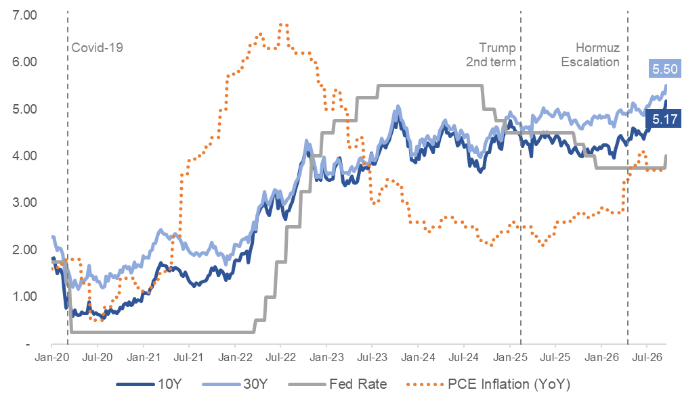
This week, the US 10-year Treasury yield touched its highest level since June 2007, and the 30-year was already above 5.3% in mid-August, a 19-year high at that time. The US Treasury tried to calm yields by doubling the size of its long-dated bond buybacks in August, then tripling them to $6 billion per operation in September. Yields fell for only one day, then moved higher again.
Howard Marks of Oaktree wrote about this in his latest memo. He says the Treasury's buybacks are like putting an ice pack on a patient with a fever. The temperature may drop for a while, but the patient won't get better until the real cause is treated.
And the causes are clear. PCE Inflation is still high, at 3.7% in July, almost double the Fed's 2% target, so the Fed turned hawkish this month. The US is also running a deficit of about 6% of GDP even though unemployment is only 4%. Interest payments on the debt are now bigger than the US defense budget.
There is one more cause, and it is the most relevant to this article: AI itself. McKinsey estimates more than $5 trillion will be spent on AI data centers through 2030. On top of that, the US needs to sell about $2 trillion of new debt every year. When everyone needs money at the same time, the price of money goes up. So the same AI boom that lifts chip stocks is also pushing rates higher.
Nobody should expect a US default. But as Stanley Druckenmiller put it, higher yields are "not a crisis. It is an invoice." The US is already paying for its fiscal indiscipline, slowly, through higher rates.
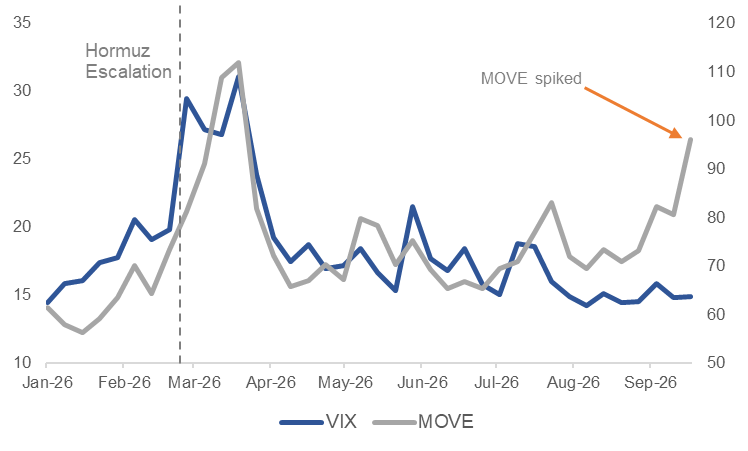
What surprises me is how resilient the equity market looks. The MOVE index, which measures fear in the bond market, has jumped, while the VIX has barely moved. History also calls for caution. In every US mid-term election year since 1990, the equal-weight S&P 500 has fallen at least 7% from mid-August to mid-October, and we are in that window now.
So, what does it mean for our positioning?
Marks makes an important point: the problem is with US fiscal management and potentially the dollar, not with US companies. Selling good US stocks to hold dollar cash or bonds doesn't remove the risk, because those carry the same dollar exposure. So this is not a reason to panic.
But higher rates do change which companies deserve a premium. When money is expensive, companies that depend on borrowing suffer most, while companies already generating earnings are better protected. That fits the CPU story well. For Intel, there is a nuance: building fabs is very capital-intensive, which makes a partner like SK Hynix sharing the Ohio site even more valuable now. Memory stays in the middle, cheap on today's earnings but discounted for the cycle, and Micron's results on 30 September could close some of the gap.
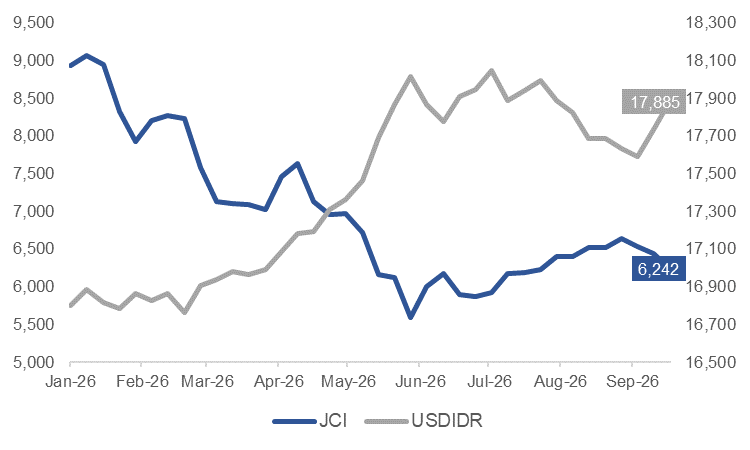
For us in Indonesia, I think the picture is clear for now. The JCI has fallen about 30% this year and the rupiah has weakened to nearly 17,900 per dollar. When the US yields rise and global markets get nervous, foreign money leaves the IDX and the rupiah gets weaker. Dollar assets protect us exactly when things go wrong at home.
That is why I prefer to stay with the dollar and ride the AI momentum in US tech, while staying light on the JCI until the rupiah stabilizes. We get a currency hedge and exposure to the companies leading the AI buildout, something the IDX cannot offer today. But it is not risk-free. The rupiah is already weak, so a recovery would cut our dollar returns, and AI stocks can fall fast when the equity market turns into fear. Not an investment advice, but it is now better to: stay with the US dollar and the AI winners that earn money today, stay light on the JCI for now, and keep watching the bond market.